 SaleHero
Use cases
The problems your team solves by hand every day
Eight situations every online shop in Romania knows. For each one: how it goes today, how it goes with SaleHero, and what changes.
The courier left with “about 80 parcels”. Two days later a customer says theirs never left.
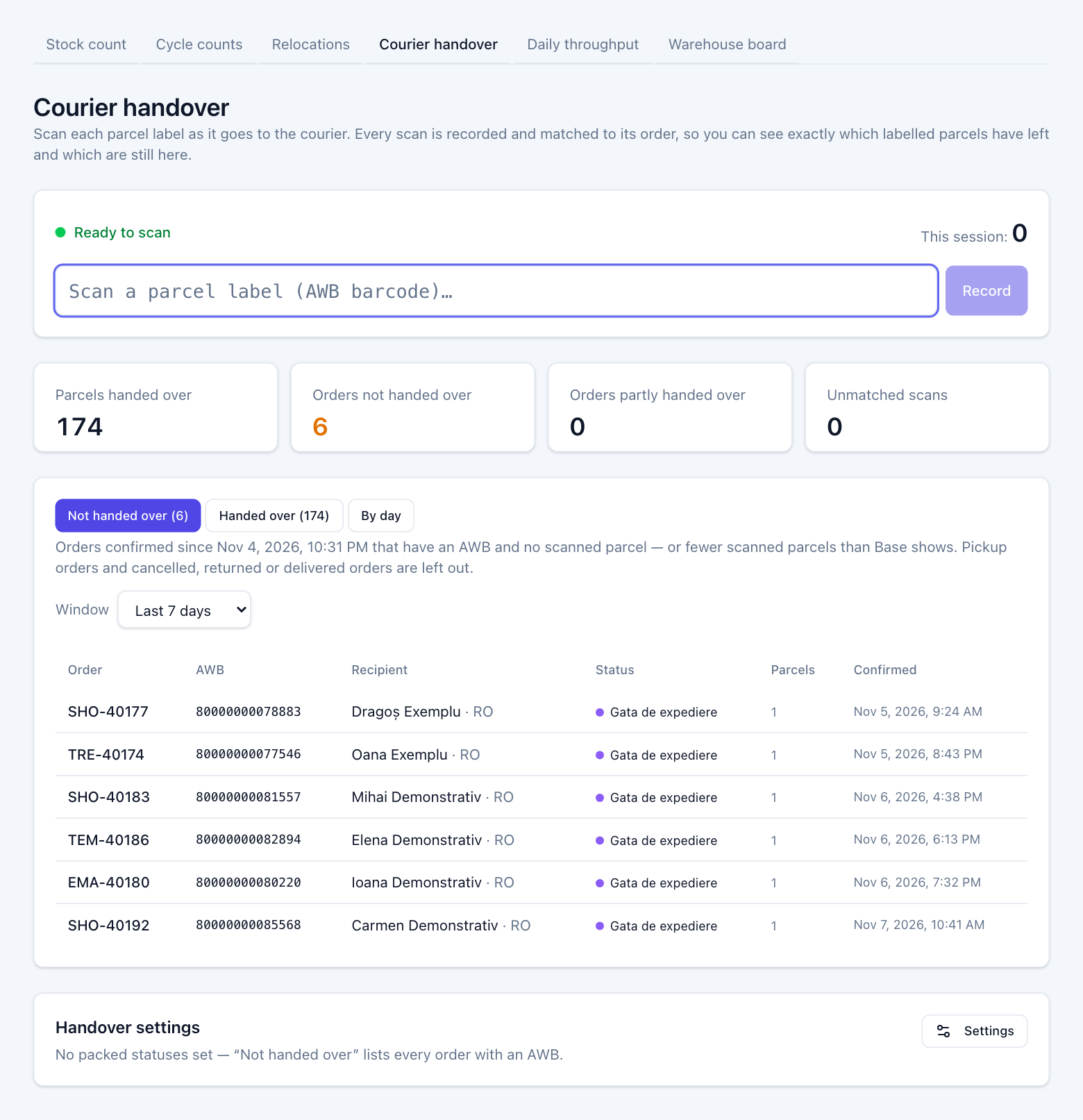
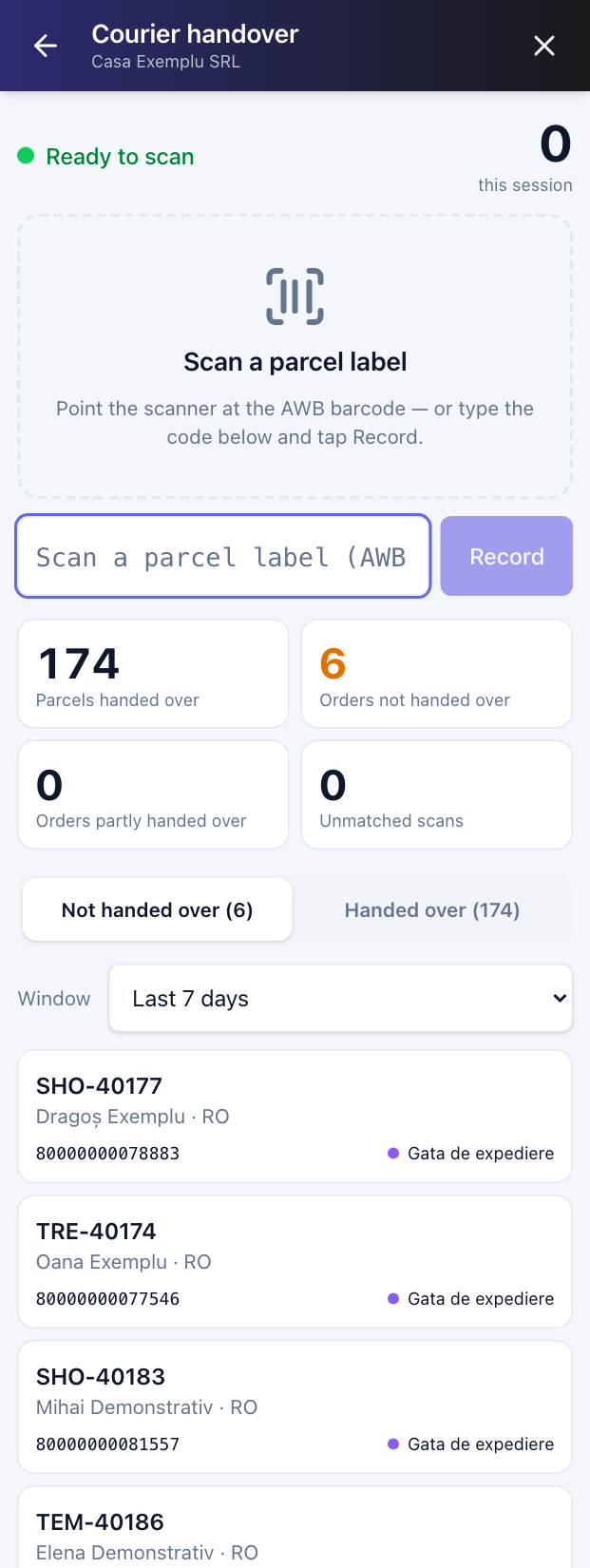
Every parcel is scanned at the courier desk and matched to its order. Before the van leaves you know what is still on the shelf, and afterwards you can prove what went.
Today
- Parcels are counted by eye at the door, if at all.
- “Handed to courier” is set by hand, or hours later from tracking.
- An order with three parcels leaves with two, and nobody notices.
- When a customer claims, there is no record that the parcel left your warehouse.
With SaleHero
- A phone at the courier desk scans each AWB. SaleHero finds the order and answers in a colour, so a wrong parcel is caught on the spot.
- Labels from DPD, Sameday, Cargus, GLS, FAN, Packeta and the marketplaces' own shipping are recognised, including the partner barcode on Packeta parcels delivered abroad.
- The handover page lists orders not handed over, orders partly handed over and scans that match no order. Unmatched scans are checked again about every 15 minutes.
- Optionally, an order moves to the status you choose once all its parcels are scanned.
What changes
- Every parcel has a scan with a date and time.
- Missing parcels are found before the courier leaves, not the next morning.
- Handover is counted from scans, not from statuses set by hand.
Four couriers, three card processors, four marketplaces. Each pays differently, and finance ticks it all off in Excel.
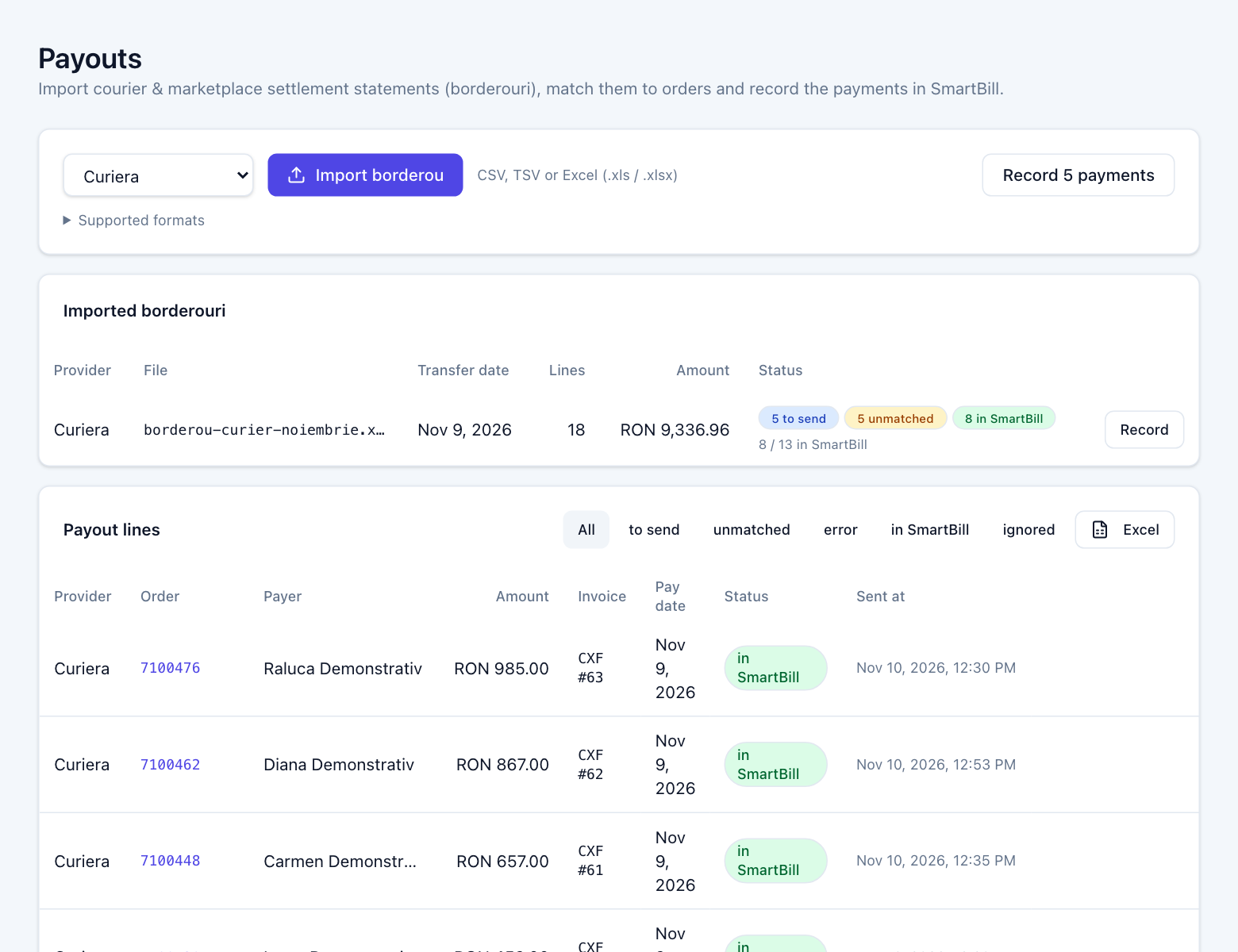
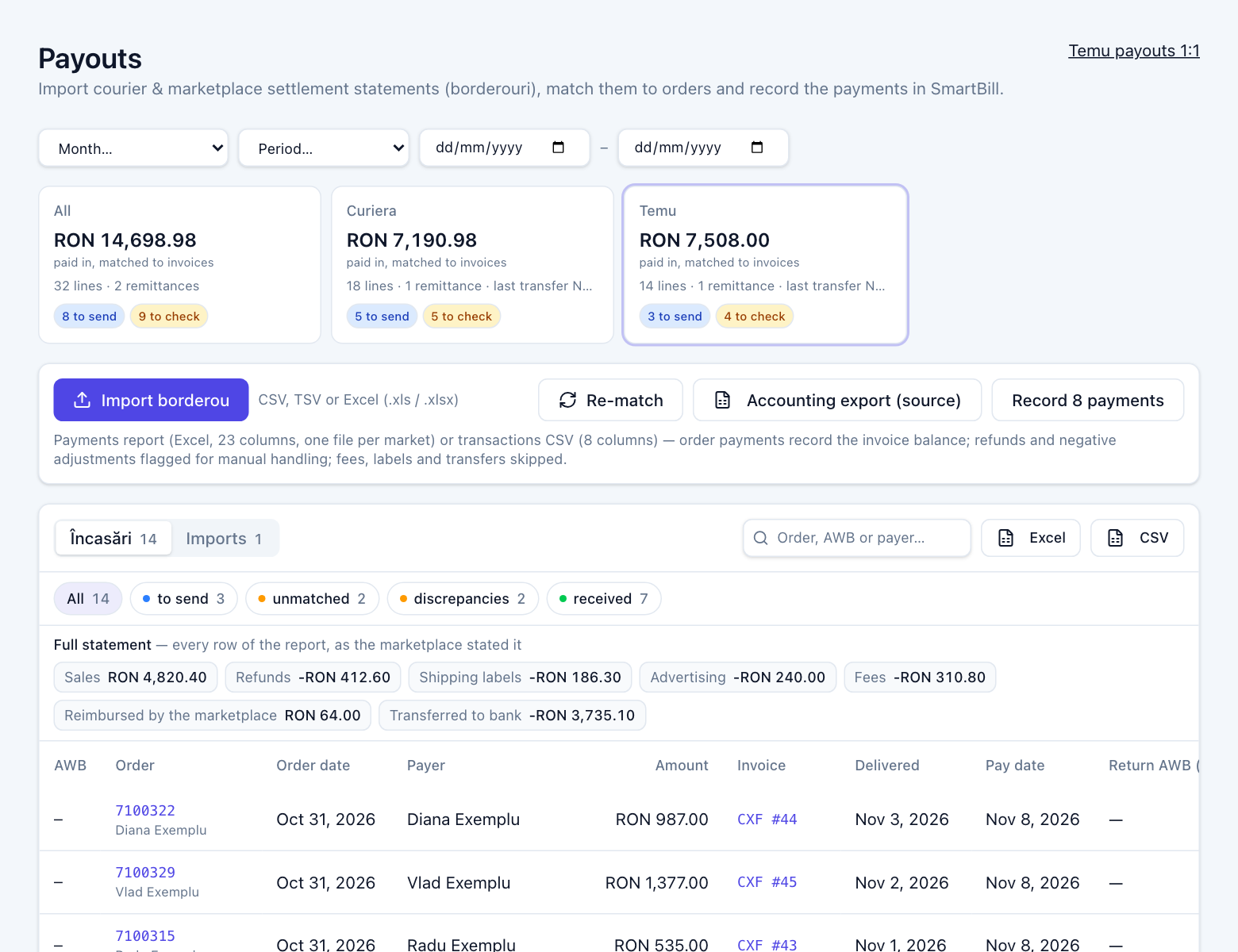
Every settlement, from couriers, payment gateways and marketplaces, is read line by line and matched to its order. The payments land on the right invoices in bulk.
Couriers · cash on delivery
One transfer for hundreds of parcels
 Packeta
 Livrăria· every hour
matched by AWB
Card payments
Paid in batches, net of fees
 Shopify PaymentsNNetopiaVViva.com
matched by order or reference
Marketplaces
Net of commission, refunds and penalties
 Trendyol
 Temu
 eMAG
matched by order number

Read line by line
- Matched126
- Recorded1,284
- Unmatched7
- Ignored3
- Error1
Each file and line counts once.

SmartBill · Invoices
Payments recorded, in bulk
1,284
Money not arrived, per source
18
Today
- The courier sends one transfer for hundreds of cash-on-delivery parcels.
- Shopify Payments, Netopia and Viva pay in batches, net of fees.
- Marketplaces pay net of commission, refunds and penalties.
- Invoices stay unpaid in the books for weeks after the money is in, and money that never came is noticed months later.
With SaleHero
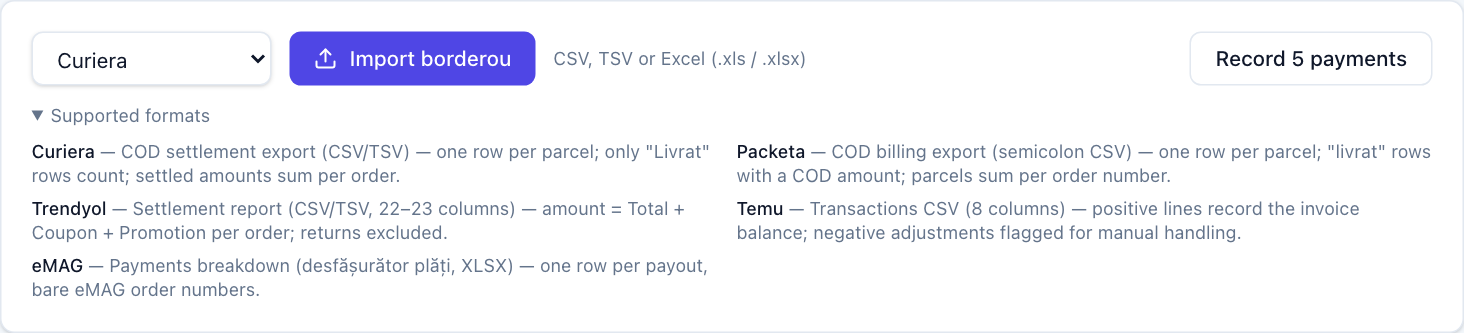
- One reader per source: courier COD statements, Packeta, Netopia, Viva.com, Shopify Payments, Trendyol, Temu and eMAG.
- Shopify Payments can be read straight from each store, without a file. Cash on delivery collected through Livrăria arrives by itself every hour.
- Each line is matched by order number, AWB or reference, and gets a status: matched, recorded, unmatched, ignored or error. The same file or line cannot be imported twice.
- Payments are recorded on the invoices many at once. Lines that arrive before their invoice are matched again later with one button.
What changes
- A statement that took a day takes minutes.
- Invoices close when the money arrives.
- You see exactly which money has not arrived, per source.
SmartBill, monday, easySales, Zendesk. Four logins, four bills, and the same order number typed into each.
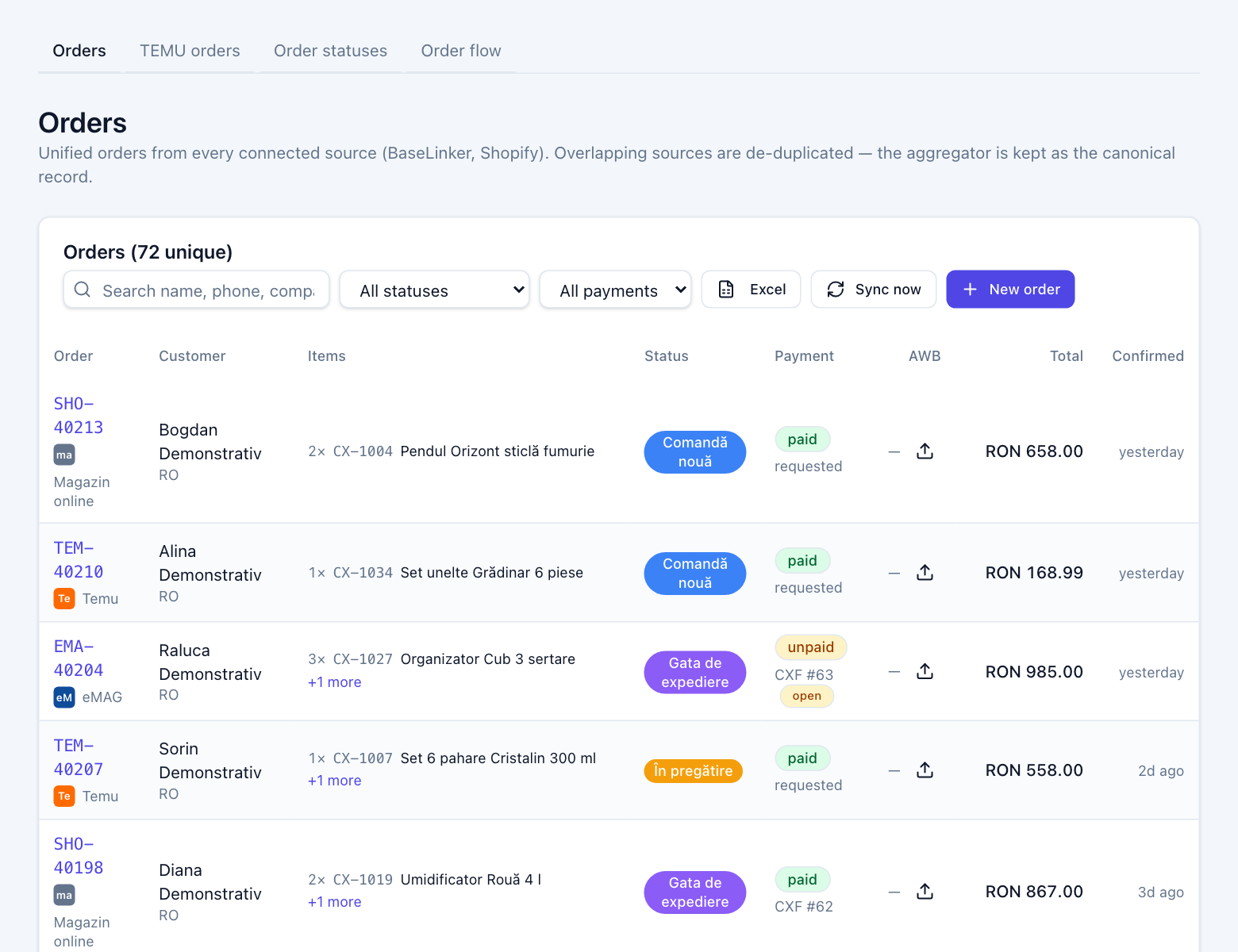
Orders, warehouse, customers, cases, the B2B shop and invoicing work on the same data in one place. Nothing is copied from one tool to the next.
Today: a program for every job(example)






- a login for each
- a bill for each
- order #10482 typed 4 times
- nobody sees the whole order
SaleHero · one system
- Orders
- Warehouse
- Customers
- Returns & cases
- B2B
- Invoicing
- Payouts
- Reports
One login · one bill · the order number typed once
- Orders from every channeleasySales, the marketplace panelsOne de-duplicated list, and the reason when an invoice or AWB failsAvailable
- Returns and casesmonday.com, spreadsheets, WhatsAppReturn form, case file, courier AWB, every step with its statusAvailable
- Customers and supportZendesk, a shared inboxA customer page with orders, returns, notes and the WhatsApp conversation. Keeping Zendesk? Its sidebar shows the same ordersAvailable
- WarehousePaper, a separate WMSHandover scans, cycle counts, relocations and a floor TV board, on a phoneAvailable
- WholesalePhone calls and ExcelA B2B portal with each client's prices, prepaid credit, feeds and an APIAvailable
- Invoicing and e-FacturaSmartBill, OblioConnected today. Invoices, credit notes and e-Factura issued from SaleHero itself are rolling outRolling out
Today
- The order lives in one tool, the invoice in another, the return on a monday board, the customer's e-mail in a helpdesk.
- Answering “where is my order?” takes five tabs.
- Every tool has its own subscription, its own users and its own export.
- When two tools disagree, nobody knows which one is right.
With SaleHero
- One order list across BaseLinker, Shopify, the B2B portal and your own staff, with the invoice, AWB, payment and timeline on the order page.
- Returns and cases (missing part, replacement) live in SaleHero, with their AWB and every step. monday.com can still get a copy, if you want it.
- One page per customer with orders, returns, refused parcels, notes and the WhatsApp conversation.
- Invoicing runs through SmartBill or Oblio today. Native invoicing in SaleHero, with e-Factura, is rolling out.
What changes
- One login and one bill instead of four.
- The customer gets an answer from one screen.
- Each fact is stored once, so there is nothing to keep in sync.
The books say 120. The shelf says 112. The accountant asks why, and nobody knows.
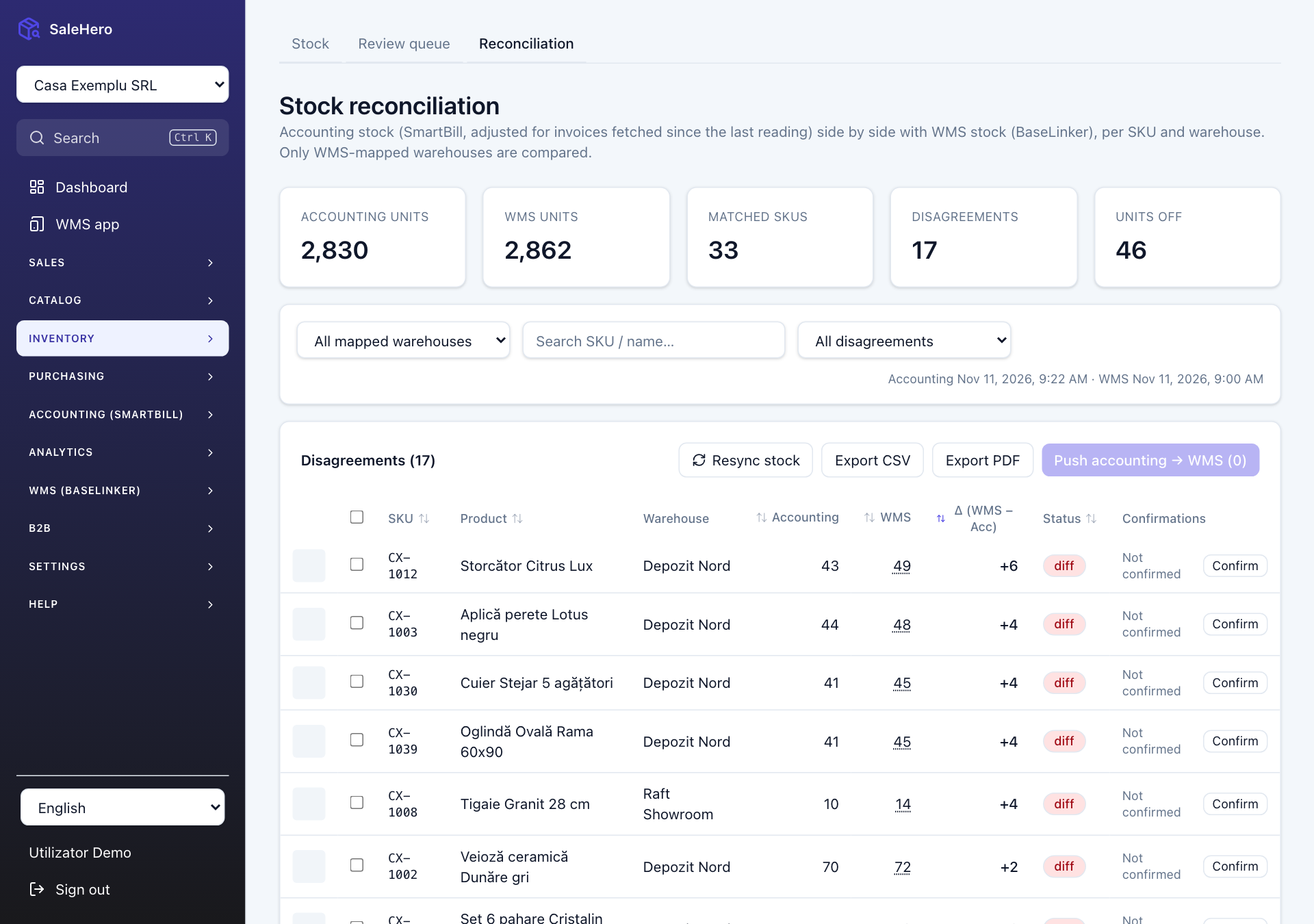
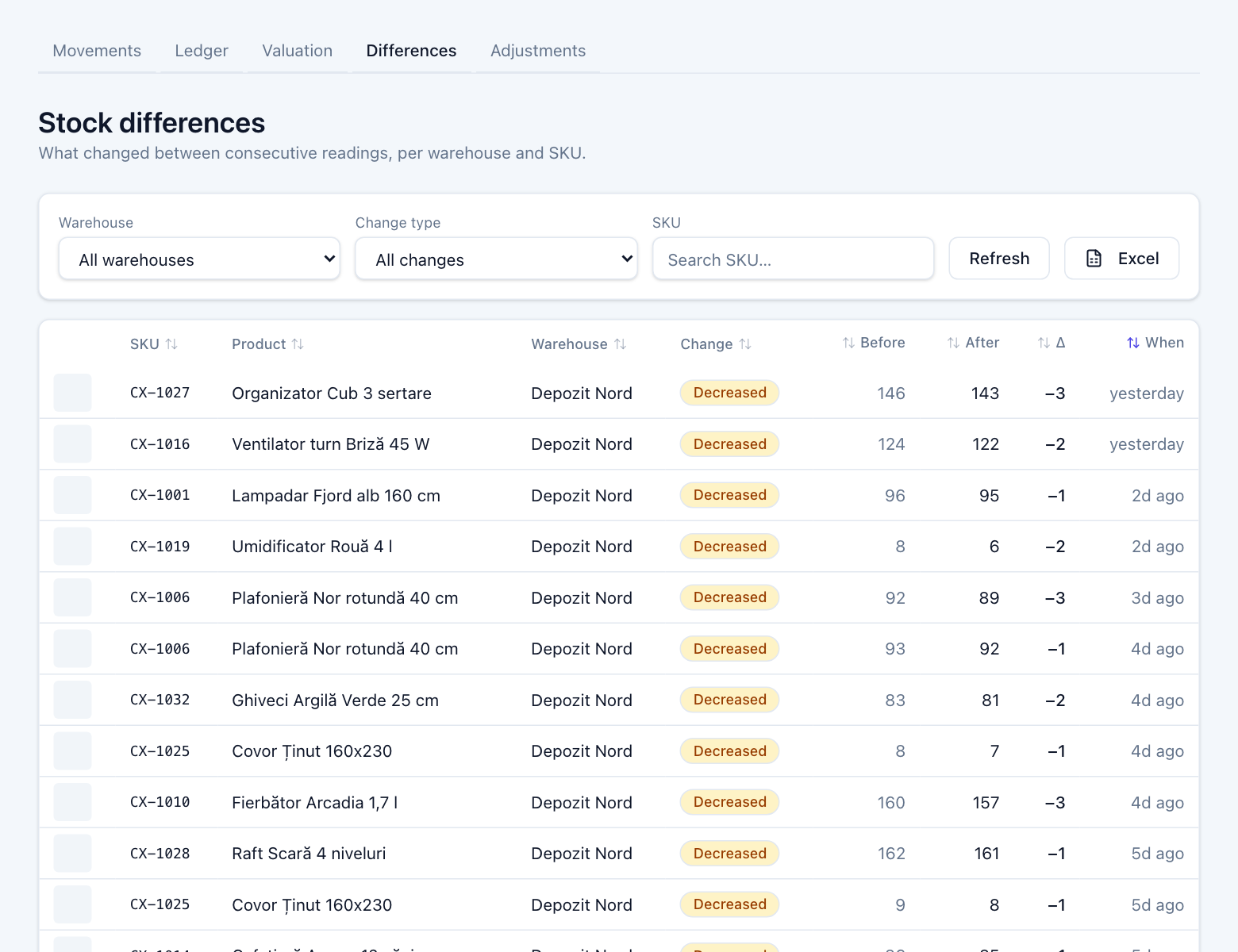
SaleHero puts the accounting stock and the warehouse stock side by side for every SKU, rebuilds the movements in between, and tells you where the gap comes from.
Today
- Accounting stock and warehouse stock drift apart a little every day.
- The yearly inventory finds the gap months after it happened.
- A reception typed in late looks like a loss until it is entered.
- Two SKUs swapped at packing show up as one surplus and one deficit, and both are adjusted by hand.
With SaleHero
- Both stocks on one screen, per SKU and warehouse: fine, different, missing in the warehouse or missing in the books.
- A ledger rebuilds the accounting stock from the opening balance, invoices and receptions, and labels each SKU: match, reception lag, surplus, deficit.
- Two SKUs wrong in opposite directions are suggested as a pair, with a CSV for the correction.
- Cycle counts pick the warehouse bins most likely to be wrong, so you count those instead of everything.
What changes
- Differences are found in days, not at the year-end inventory.
- Each gap has an explanation or is flagged as unexplained.
- The accountant gets a list, not a question.
The wattage is in the title, the socket is in a PDF, and every channel wants it typed again.
Specifications are defined once per category, filled from what you already have, and pushed to your store's filters and your B2B feeds.
SaleHero PIM · the one source
LED-4021 ceiling light
- Power12 W
- SocketGU10
- Colour temperature3000 K
- DimmableYes
Edited once, here. Each channel gets its own field names, units and options.
ShopifymetafieldsLive- custom.putere12
- custom.dulieGU10
- custom.temperatura_culoare3000
- custom.dimabiltrue
eMAGcharacteristicsComing soon- Putere (W)12
- Tip socluGU10
- Temperatura culoare (K)3000
- DimabilDa
TrendyolattributesComing soon- Putere11–20 W
- SocluGU10
- Culoare luminăAlb cald
- ReglabilDa
Change a value in SaleHero and every channel gets it. Field names are examples.
Today
- The same lamp has “40W” in one channel and “40 W” in another.
- Store filters miss half the products because the field is empty.
- Every new marketplace means retyping the specs into its template.
- EANs and names differ between the order system, the books and the store.
With SaleHero
- Attributes per category, as text, number, yes/no or a list of options, with units and the ones each category requires. Completeness is measured per category.
- Empty values are filled from product titles, from BaseLinker features and from the Shopify metafields already there. A value typed by hand is never overwritten by an import.
- Values go to Shopify metafields, with ranges the store can filter on, and to B2B feeds with one column per specification.
- A conflicts page lists SKUs whose EAN, name or price differ between systems.
What changes
- A spec is typed once.
- Store filters find every product.
- A new channel starts from complete data.
We discount what is about to run out, and sit on what does not move.
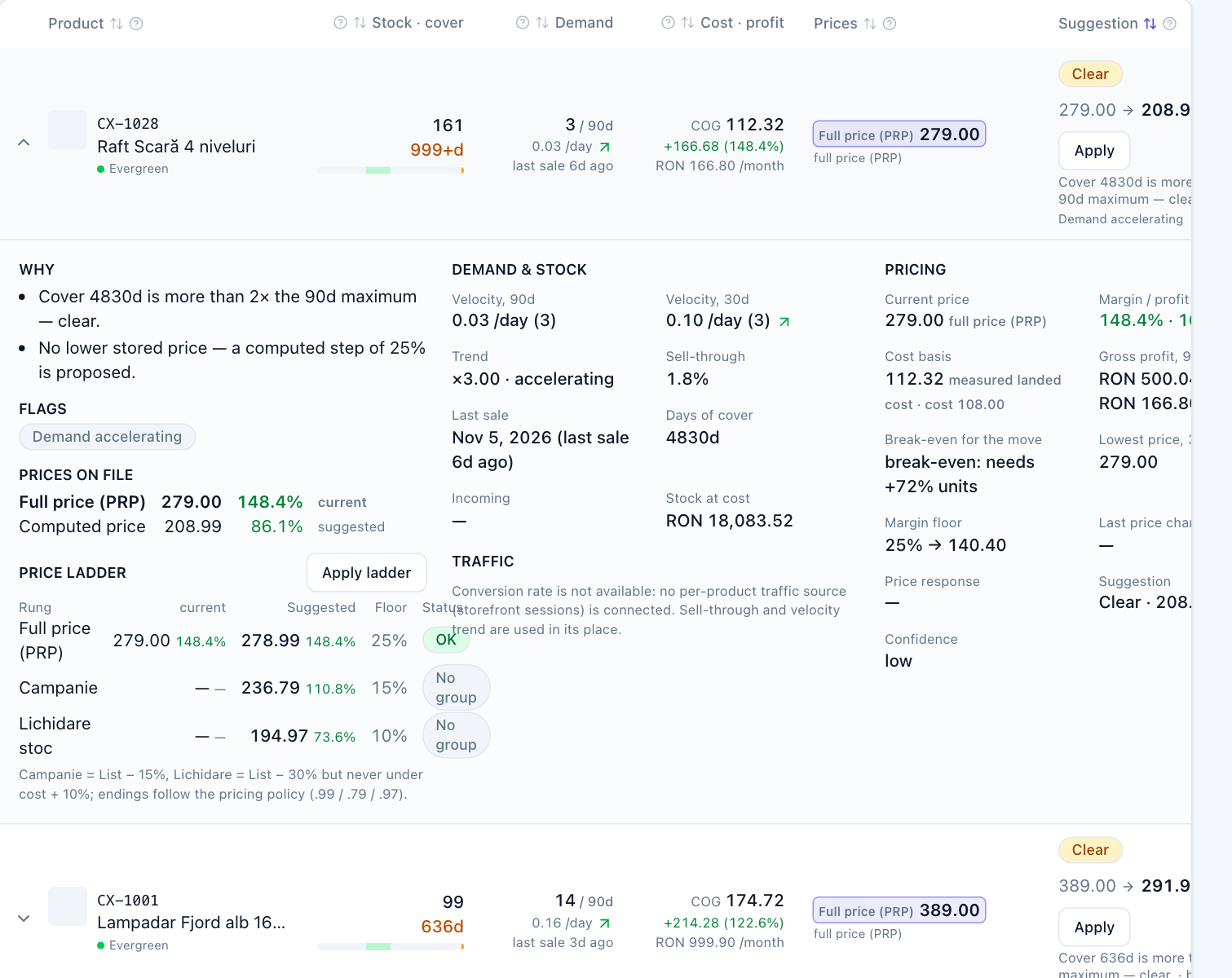
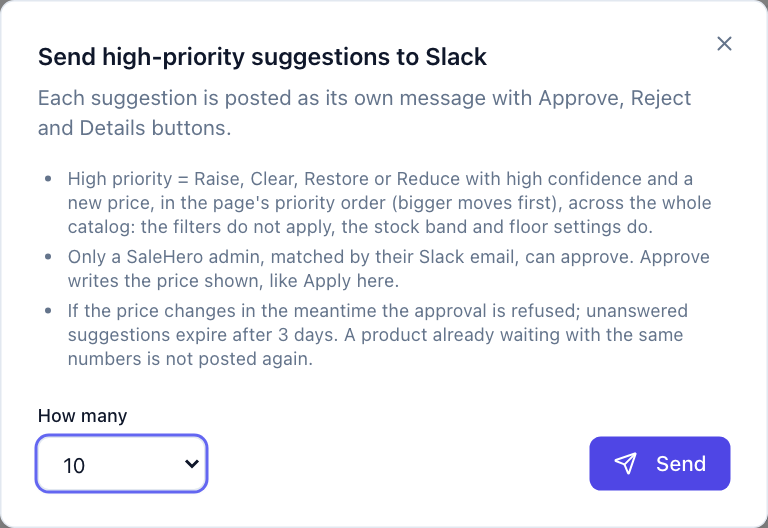
The pricing engine reads stock cover, sales speed, store traffic, incoming containers and your margin floors, and proposes a price for every product, with the reason.
This week's suggestions
Pendant lamp P-118
A bestseller almost gone, still on promotion
Stock cover: 9 days
Sold: 62 in 30 days
RestoreCampaign 149.99List 179.99Next container in 41 days: stop discounting it.
Ceiling light LED-4021
Running out, nothing on order
Stock cover: 12 days
Sold: 40 in 30 days
Raise219.99229.99+5%, so the last units earn more.
Wall light W-07
Sells, but slowly
Stock cover: 190 days
Sold: 6 in 30 days
Reduce189.99169.99−10%, margin still 32%.
Floor lamp F-22
Nothing sold in 90 days
Stock cover: no sales
Sold: 0 in 90 days
Clear399.99Clearance 279.99Never under cost + 10%.
GU10 spot set, on eMAG
Priced under the margin floor
Stock cover: 70 days
Sold: 18 in 30 days
Hold39.99Under your 25% floor: flagged, never lowered further.
You choose the trade-off
Margin first
Floor 35% · healthy cover 60–120 days
Fewer discounts; slow stock waits longer for its price.
Balanceddefault
Floor 25% · healthy cover 60–90 days
Where the engine starts.
Volume first
Floor 15% · healthy cover 30–60 days
Stock turns faster and cash comes back sooner.
Margin floors and the healthy stock cover are your settings; the engine works inside them.
Today
- Prices change on gut feeling, in six panels.
- A bestseller goes on promotion while the next container is three weeks away.
- Slow stock stays at full price and ties up cash.
- A marketplace price ends up below cost, and nobody sees it.
With SaleHero
- Each product gets an action, raise, restore, hold, reduce or clear, from its days of cover against how fast it sells.
- Demand comes from orders and from store traffic: views and add-to-carts from Google Analytics or Shopify.
- Supply counts what is already on the way, so a product with a container arriving is not raised as if it were running out.
- Never below your margin floor. Each suggestion shows its reason; you apply it after review, or approve it from Slack.
What changes
- Low stock stops being discounted.
- Slow stock rotates before it gets old.
- Every price change has a reason you can read.
Temu refunded part of a 149 lei order and the customer kept the goods. What does the accountant book?
Marketplace refunds are read from the settlement, checked against whether the goods came back, and turned into the right accounting document, to the cent.
Temu settlement
Order PO-211-04829173
refund −49.00 lei
partialBack in the warehouse?
No
AWB tracking + Temu case: returnless
Discount invoice, same series
−49.00 lei · VAT 21% (RO)
149.00 − 49.00 = 100.00 lei
= what Temu paid
- A full refund becomes a credit note.
- Goods not returned: flagged for a consumption note.
Today
- Refunds arrive as negative lines inside a payout, mixed with the sales.
- A full refund, a partial refund and a refund without return each need a different document.
- The marketplace net never equals the invoice, so the order stays open.
- Whether the goods came back lives on a separate returns board.
With SaleHero
- Each refund line is tied to its order and invoice.
- Whether the goods came back is read from the return AWB's tracking and from the Temu after-sales case. A refund-only (returnless) case means nothing comes back, so nothing is waited for.
- A full refund becomes a credit note on the invoice. A partial one becomes a discount invoice on the same series, at the delivery country's VAT, for exactly the refund.
- A refund larger than the invoice, or one that cannot be compared, is refused and left to a person. Goods that never came back are flagged for a consumption note.
What changes
- Invoice minus credit note or discount equals what the marketplace paid, to the cent.
- Finance presses one button per refund instead of researching each one.
- Refunds without a return no longer disappear from stock unexplained.
Five subscriptions, five price lists, and every renewal costs more than the last.
One price that follows your volume: you pay for the orders you ship. Fair pricing, forever.
What you pay for today · 7
- Order managerper order
- Warehouse appper user
- Product information (PIM)per product
- Repricing toolper channel
- Payment reconciliationper statement
- Returns portalper return
- Profit reportsper seat
7 × renews at a new price
One subscription
9.99 EUR
per 1,000 orders / month
Orders, warehouse, catalog, pricing, payments, returns and profit, in one app.
No users, channels or products to count. AI and deep analysis are optional extras.
Pilot
0 EUR
The first 6 months, core app
After the pilot
9.99 EUR
per 1,000 orders / month
Billed monthly, plus VAT
Advanced modules
AI, deep analysis, multi-company flows and custom components are priced separately. Turn them on only if you need them.
Today
- Each tool charges by its own unit: users, modules, channels, invoices.
- Adding a marketplace or a colleague raises three bills at once.
- Prices change at renewal, when switching is hardest.
With SaleHero
- The first six months of the core app are free.
- After that, one price per 1,000 orders a month.
- Advanced modules, such as AI and deep analysis, are separate and optional: you switch on only what you use.
What changes
- A bill you can work out from your order count.
- A quiet month costs less.
- No surprise at renewal.
Recognise one of these?
Start with the one that hurts most. The rest is already there when you need it.